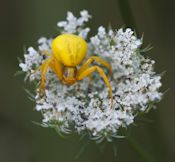
Goldenrod crab spider

FODMers Help With National BioBlitz

During the May 20 and 21, 2016, national BioBlitz, FODMers, National Park Service (NPS) staff and friends identified 13 new spider species in the Dyke Marsh-Belle Haven Park area. Other records for Dyke Marsh: the first spring record for a Philadelphia vireo (Vireo philadelphicus); the second record for the hoary bat (Lasiurus cinereus); one new earthworm (Bimastos palustris), a native species; and two new terrestrial isopods (Porcellio laevis, Trichoniscus pusillus).  At our “sister” park, Theodore Roosevelt Island, people found 17 new lichens.

skinks

Spring Brings Breeding Skinks

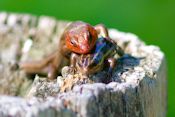
Spring is breeding time in Dyke Marsh for many species of wildlife, including skinks. The American five-lined skink, (Plestiodon fasciatus), is one of the most commonly seen lizards in eastern North America and is frequently observed around logs along the Haul Road Trail (photo, skinks mating May 2016 by Ed Eder). 

Caterpillar

The Interdependence of Natural Resources

At the quarterly meeting of FODMers and friends on May 11, 2016, Alan Ford and Laura Beaty gave a presentation on the interrelationships of plants and animals and the important role of pollinators and leaf-eaters.  Alan is president of the Potowmack Chapter of the Virginia Native Plant Society and Laura chairs the Propagation Committee.

great blue heron

Ospreys Are Resourceful, but Fishing Line Is a Danger

Every spring, FODMers welcome the spring return of the ospreys (Pandion haliaetus) to Dyke Marsh and the Potomac River shoreline where these magnificent raptors build and refurbish their nests and raise their young.   In recent years, there have been approximately 10 to 12 active osprey nests within FODM’s breeding bird survey tract, a three-mile area that extends from the Porto Vecchio condominiums near Hunting Creek to south of Morningside Lane.  

Despite the rebound in the osprey population, threats still exist. 

Canada geese

T.C. Williams Students Visit Dyke Marsh

On the morning of April 29, 2016, 24 students and three teachers from Alexandria’s T.C. Williams High School’s International Academy visited Dyke Marsh to observe in action some of the lessons of their biology class and to try their hand at suppression of invasive plants. 

Butterfly

Lepidoptera and Odonata Surveys Underway

Volunteers began lepidoptera and odonata surveys in Dyke Marsh on April 20, 2016, led by Jim Waggener. On the 20th, surveyors identified five butterfly species in a brief span.  The peak time for surveys is May through September. This work helps identify and save critical habitat that preserves biodiversity in our region. 

Peregrine falcon

Raptor Rapture 2016

Under a steady drizzle, a steady stream of raptor fans attended the annual Raptor Rapture in Belle Haven Park on April 23, 2016, sponsored by FODM, the Raptor Conservancy of Virginia and the National Park Service.

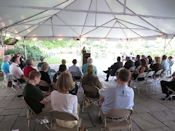
Kent Knowles (pictured) and Gabby Hrycyshyn of the Conservancy brought an Eastern screech owl (gray morph), an American kestrel, peregrine falcon (photo), red-tailed hawk, barn owl and Harris’s hawk.  These birds cannot live on their own in the wild. 

Northern rough-winged swallow

Breeding Birds Are Resourceful in Choosing Nest Sites

As the weather warms, birds are busy breeding in the Dyke Marsh Wildlife Preserve.  In April, FODMers observed red-bellied woodpeckers and northern flickers investigating potential nest cavities, despite facing stiff competition from European starlings.  Observers have seen Carolina chickadees and fish crows carrying nesting material in the Belle Haven picnic area and along the Haul Road. 

Cleanup

Attacking that Never-Ending Trash

On April 16, 2016, 66 enthusiastic volunteers of all ages turned out on a beautiful spring day and collected trash along the Potomac River and Dyke Marsh shoreline.  The group found plastic bottles, aluminum cans, fast food boxes and wrappers, plastic bags, pieces of Styrofoam, at least two tires and more – too much.

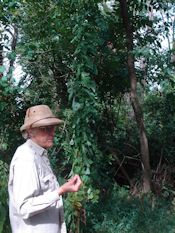
Ned Stone

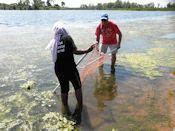
Water Quality Testing Finds Impaired Streams Flowing into Dyke Marsh

FODMers, guided by Dan Schwartz, soil scientist, Northern Virginia Soil and Water Conservation District, conducted biological water quality testing on two unnamed streams flowing into the western part of Dyke Marsh on April 2 and June 11, 2016. 

The findings are disappointing, but not surprising.  Most streams in Fairfax County are impaired.

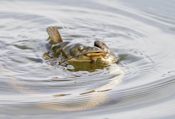
American bullfrog

Frog and Toad Surveys Are Underway

Thanks to members Laura Sebastianelli and Deborah Hammer, FODMers are conducting a frog and toad survey in Dyke Marsh and other areas, as part of the FrogWatchUSA national monitoring program.  People living near Dyke Marsh West have heard fewer frog and toad calls in recent years and FODM would like to document species and trends.

Jessie Strother

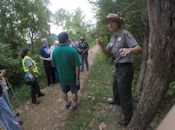
Do Trees Have Antifreeze?

FODM Board member Jessica Strother, a forester, led a walk on February 27, 2016, and described three of the ecotones of the preserve:  the swamp forest, the floodplain forest and the tidal marsh.  She explained that trees breathe through their leaves and root system.  Trees like the pumpkin ash tolerate water, but cedars like drier, upland soil.